Chatbot for Commercial Real Estate: Capture Clear Property Inquiries
A practical commercial property inquiry workflow with fictional office data, original scripts, clear units and broker review.

A commercial property inquiry rarely starts and ends with “How many bedrooms?” A business operator may need an office within a stated area range, a retail location for a particular activity, or industrial space with questions about loading access. A chatbot for commercial real estate can help organize that first conversation around approved listing facts and a broker’s next action.
The useful outcome is a correctable requirement brief, not an automated decision about a transaction. This guide describes a proposed workflow with fictional US property data and original conversations. It is not a demonstration of a deployed SchoolsAI commercial real estate integration. Current availability, suitability, commercial terms, and tour arrangements still require the appropriate people to verify them.

Start with the commercial inquiry intent
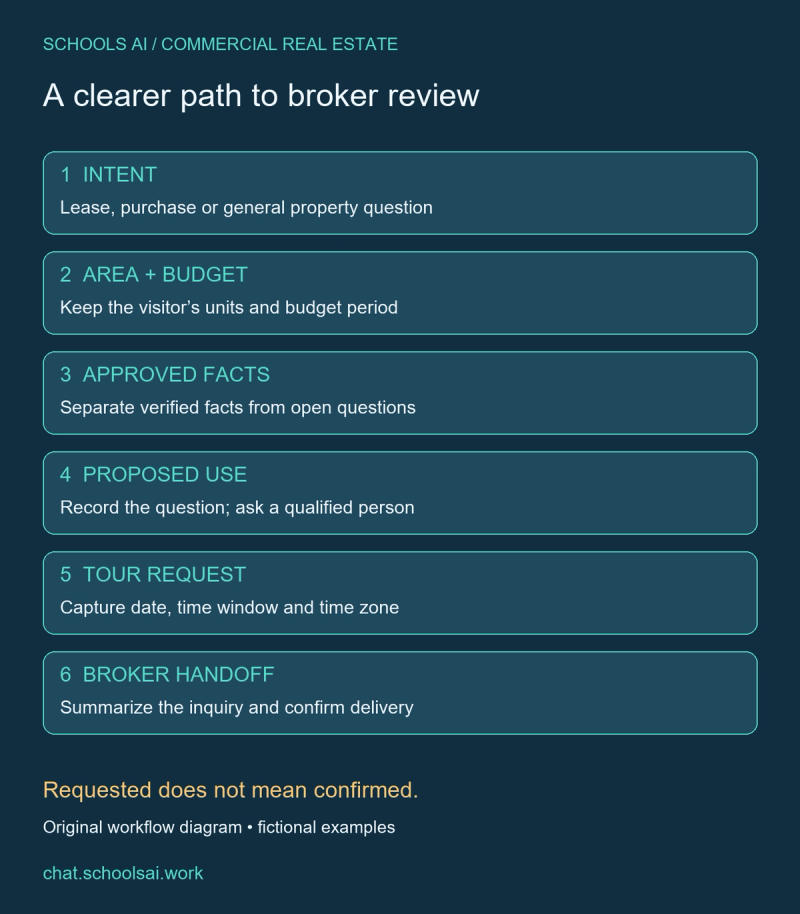
Ask whether the visitor wants to lease space, acquire a property, or discuss an existing property matter. These paths need different follow-up questions. A leasing inquiry should not be forced through an acquisition questionnaire, and an existing tenant asking for assistance should reach the correct service contact rather than becoming a new sales lead.
An opening might say: “I’m an automated property inquiry assistant. Are you looking for space to lease, a property to acquire, or help with an existing location? You can ask for a person at any time.” If the visitor already names the listing and purpose, keep that context and move directly to the missing information.
Here, commercial real estate lead qualification means clarifying the inquiry for broker follow-up. It does not mean approving a tenant, assessing financing, or deciding whether a proposed activity is permitted. Keep those judgments outside the intake conversation. Someone asking a simple property question should also be able to receive an approved answer without surrendering contact details first.

Capture area and budget with their original units
Record the desired location, asset type, approximate area, intended timing, and the visitor’s stated price or rent range. Preserve the unit and period they used. “Around 3,000 square feet” and “up to $8,000 a month” should remain recognizable in the summary; the assistant should not silently turn them into a different requirement.
Ask a clarifying question when a figure lacks context: “Is that a monthly total budget or a quoted rate per square foot?” If a listing uses a different area basis or rate convention, flag the mismatch for the broker. Do not infer that two figures are directly comparable or calculate an all-in occupancy commitment from incomplete data.
Capture what the visitor knows and let them skip optional questions. A person exploring a move may not have an exact area range or target date yet. Mark those fields as approximate or not provided. Repeatedly demanding a number can produce a falsely precise brief that makes the broker’s first call harder.

Record proposed use as a question for review
Office, retail, and industrial conversations need room for different practical details. A business might mention meeting space, customer access, storage, deliveries, or a layout change. Record those needs in the visitor’s words and distinguish a requirement from a question. Avoid translating “we would like” into “this property provides.”
For a retail inquiry, ask: “What activity are you considering, and which property details would you like the broker to check?” A visitor might describe a small showroom with customer visits. The assistant can carry that description forward without asserting that the activity is approved, that alterations will be allowed, or that a particular capacity is available.
Route interpretation of permitted use, contract language, technical specifications, and build-out commitments to qualified staff. If a prospect asks for advice about investment returns or financing, preserve the question for the appropriate person. Do not invent an answer to keep the conversation moving. An explicit unknown is more useful than a confident statement the team must later correct.

Build an approved commercial listing record
Use a stable property reference, a staff owner, a source, and a verification date. Separate public listing facts from private notes and unresolved details. The same discipline used in the real estate inquiry workflow applies here, with commercial fields replacing residential assumptions.
For this fictional training example, record CRE-O204 as an office suite in a sample Austin, Texas market. Its sample area is 2,800 square feet, with the measurement basis still needing verification. The approved training record does not supply a verified asking rent, current availability, alteration policy, or access arrangement. Those fields remain unknown; the assistant must not fill them from a similar listing.
Give records an update process. If the information is stale, conflicting, or unavailable, the response should say the team needs to check it. Do not expose private owner details, access codes, confidential negotiation notes, or internal instructions in a general website chat. A public inquiry needs a broker contact pathway, not unattended property access.

Example conversation for an office leasing inquiry
Visitor: “We need roughly 2,500 to 3,000 square feet near Austin. Can we see CRE-O204 next Thursday?”
Assistant: “I can collect a tour request for the broker to check. The sample record lists 2,800 square feet, but the team needs to verify the area basis and current availability. Do you mean Thursday, October 29, 2026? What time window and time zone work for you?”
Visitor: “Yes, between 10 and noon Central. We want office space for a small design team. Our target is about $8,000 a month total.”
Assistant: “I’ve noted office use for a design team, approximately 2,500–3,000 square feet, and a stated total monthly budget around $8,000. The broker needs to review the costs and requirements; I don’t have a verified asking rent. Are there other details they should check?”
Visitor: “Whether we can change the meeting room layout.”
Assistant: “I’ll preserve that as an open question. Your requested tour window is October 29, 10 a.m.–noon Central; it is not confirmed. What name and contact method would you prefer for this inquiry?”
After the visitor supplies contact information, ask permission to respond about this request and show a summary they can correct. Only acknowledge successful delivery after the configured destination reports success. If delivery fails, explain that the request was not delivered and offer a verified contact alternative. These lines are a simulated script, not evidence that a CRM or calendar connection is active.
Give the broker a brief with visible open questions
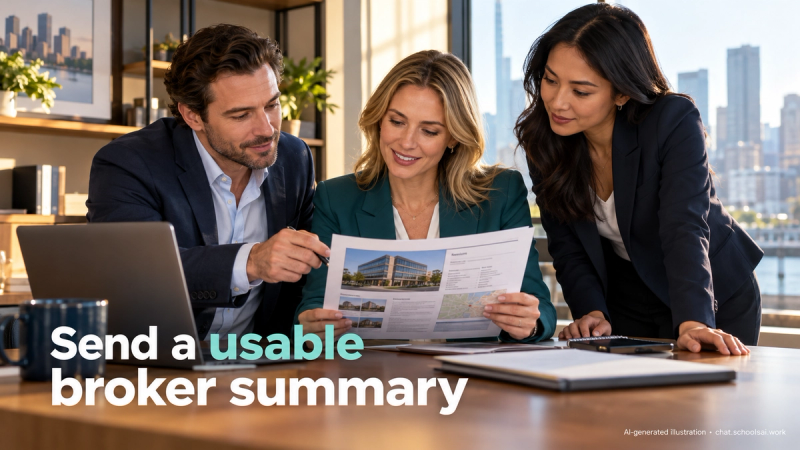
Keep the handoff compact: inquiry type, property reference, location, proposed use, approximate area with units, stated budget with period, timeline, tour preference, chosen contact method, and inquiry-specific permission. Add unresolved questions and delivery status. Assign a staff owner through the team’s verified process.
For CRE-O204, the open items are current availability, the area basis, rent and additional costs, layout changes, and tour access. The prospect’s $8,000 monthly target is a stated preference, not an accepted offer or a finding that the property fits. Set appointment confirmation to false until an authorized person or tested scheduling process actually confirms it.
Retain corrections. If the visitor changes the area range, label the new requirement and preserve useful context for staff. If they withdraw a tour request, record that withdrawal without pretending a calendar event has been canceled. Any claim that an external action happened requires a verified result.
Test commercial exceptions before launch
Test an inquiry with missing rent units, an approximate area, two similar suite references, a stale availability record, a proposed use that needs review, a human request, and failed delivery. Check both the visitor response and the broker’s received summary. Confirm that unknowns survive the handoff and optional fields remain optional.
The buyer, seller, and rental script guide offers additional wording for corrections and uncertainty. Adapt the structure to commercial conversations rather than copying residential questions into every branch. Review the finished script with the people responsible for the actual property information and follow-up process.
Discuss your commercial inquiry workflow with SchoolsAI. Bring a small approved listing set, the fields your brokers need, and a named handoff owner. Verify data sources, delivery channels, and scheduling behavior before describing the workflow as operational.
Plan a clearer broker handoff
Bring approved listing records, commercial intake fields and a named staff owner.
Discuss your commercial inquiry workflow →Keep reading

Real Estate Chatbot Scripts: Buyer, Seller & Rental Conversations
Original conversation scripts for buyer, seller and rental inquiries, with fictional listing data and clear staff handoff rules.
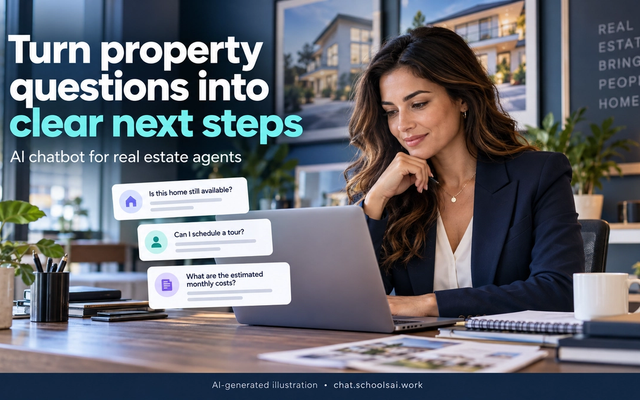
AI Chatbot for Real Estate Agents: Qualify Leads & Capture Viewing Requests
A practical inquiry workflow with fictional listing data, original conversations, and clear rules for agent follow-up.